
REA Registration in Spain and Posting of Workers: a Complete Guide for Foreign Companies
What foreign contractors and subcontractors need to know before starting construction, installation, engineering or industrial work in Spain: REA registration, the Law 45/1999 posting notification and how the two connect.
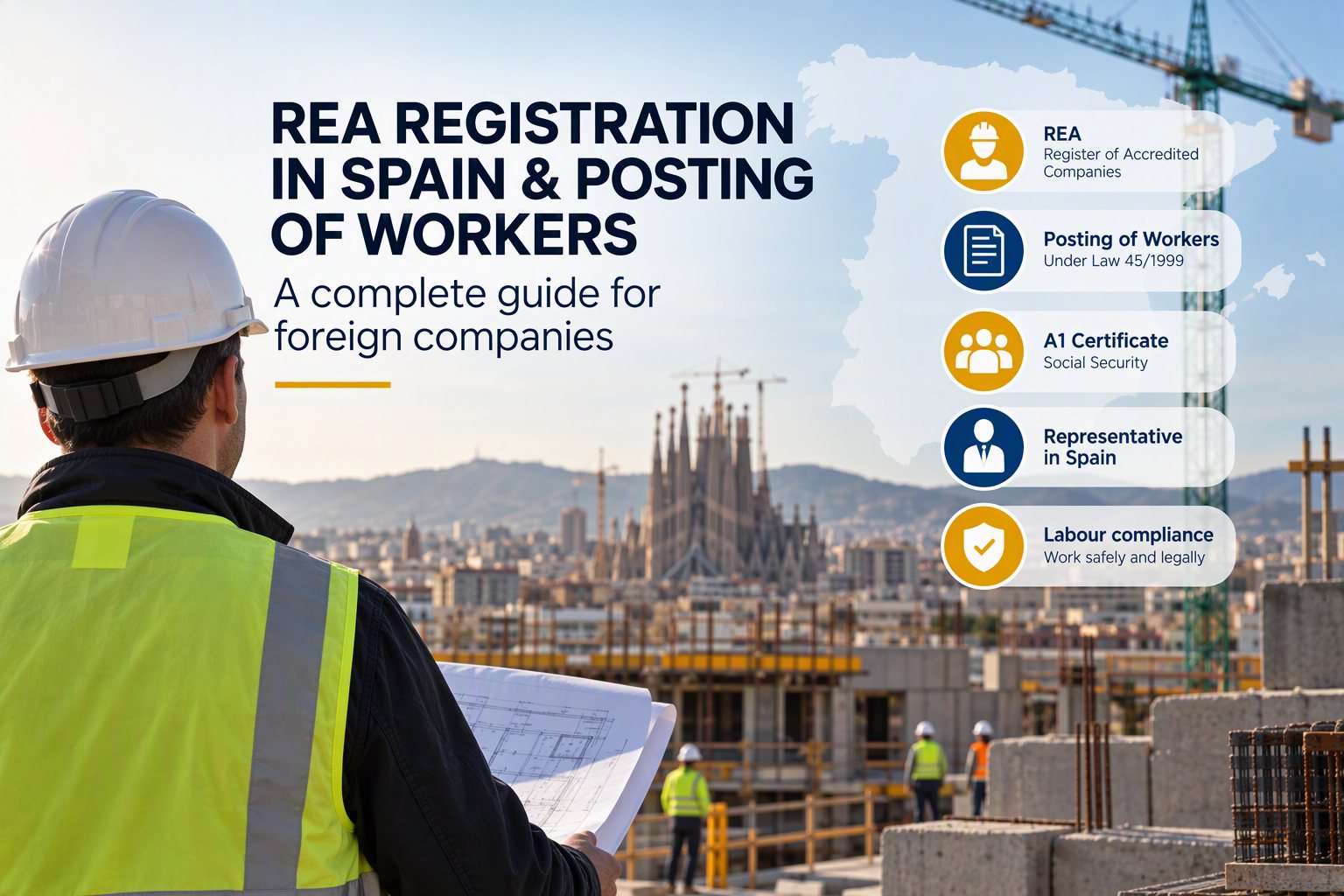
A company established in another European country can provide services temporarily in Spain without setting up a Spanish subsidiary. But sending its own employees to a Spanish construction site triggers two separate obligations that are closely connected in practice: registration in the Registro de Empresas Acreditadas (REA) and the prior notification of posted workers under Law 45/1999.
Spain is an important destination for European companies carrying out construction, industrial installation, engineering, machinery assembly, renewable energy, maintenance and infrastructure projects. Understanding how these two regimes fit together before mobilisation helps the company organise its documents, answer client and contractor requests, and start the project with a compliant structure already in place.
1. Can a foreign company work on a construction project in Spain?
Yes. A company established in another EU Member State or EEA country may temporarily provide services in Spain and send its own employees to perform the contracted work.
When the employees remain employed by the foreign company and travel to Spain for a limited period to carry out a cross-border contract, the situation may constitute a posting of workers in the framework of a transnational provision of services.
Law 45/1999 of 29 November applies to companies established in an EU Member State or an EEA state that temporarily post workers to Spain. Under Article 2, the main situations covered are:
- A worker is sent to Spain under the direction of the foreign employer to perform a contract concluded between that employer and a recipient of services established or operating in Spain.
- A worker is sent to a workplace belonging to the same company or to another company within the same corporate group.
- A temporary employment agency posts a worker to a user company established or operating in Spain, including the chain-posting situations regulated by the legislation.
Worth checking
The employment relationship with the posting company must continue during the posting. A business trip without the provision of services is not the same as a transnational posting, so the precise facts of each assignment should be reviewed.
2. What is the Spanish REA?
REA stands for Registro de Empresas Acreditadas, the Register of Accredited Companies. It forms part of the legal framework governing subcontracting in the Spanish construction sector.
The principal legislation is Law 32/2006 of 18 October, regulating subcontracting in the construction sector, together with Royal Decree 1109/2007 of 24 August, which develops that law and regulates the registration procedure.
The REA is not merely an administrative list. Its purpose is to provide evidence that contractors and subcontractors meet the legal requirements to participate in construction subcontracting, particularly as regards their productive organisation, resources, management of the work, occupational risk prevention organisation and preventive training.
Article 4 of Law 32/2006 requires a contractor or subcontractor to have its own productive organisation, the necessary material and human resources, and direct organisational and managerial control over the work performed by its employees. The company must also assume the risks, responsibilities and obligations inherent in its business activity.
3. Which activities fall within the construction subcontracting rules?
The scope of Law 32/2006 is not limited to companies whose main commercial classification is construction. What matters is the contract, the work actually performed, and whether that work is carried out on a construction site within the subcontracting chain.
Article 2 of Law 32/2006 lists the following work when performed on construction sites:
- Excavation and earthmoving.
- Construction work.
- Assembly and dismantling of prefabricated elements.
- Fitting-out work and installations.
- Transformation and refurbishment.
- Repair, dismantling and demolition.
- Maintenance and conservation.
- Painting and cleaning work associated with a construction project.
- Sanitation work.
This is especially relevant for foreign industrial, mechanical, electrical, energy and machinery companies. A company may not describe itself as a traditional building contractor, yet part of its Spanish project may still involve installation, assembly, repair or maintenance carried out within a construction project.
Practical test
Do not decide whether the REA applies by looking only at the company name or industry code. Review the Spanish contract, the project location, the scope of work and the company position in the contracting chain.
4. Can a foreign company obtain REA registration?
Yes. Spanish legislation expressly contemplates foreign companies that post their employees to Spain to carry out work within the construction subcontracting framework.
The First Additional Provision of Royal Decree 1109/2007 establishes specific rules for companies that fall within the scope of the regulation and post workers to Spain under Law 45/1999.
The company does not need to incorporate a Spanish company merely to obtain REA registration. The foreign legal entity can be the applicant and the employer posting the workers. The identification, representation and documentation for the application do, however, need to be prepared carefully.
Questions concerning a Spanish tax identification number should be assessed separately. Tax registration, VAT, permanent establishment and invoicing depend on the company activities and tax circumstances, and are not automatically resolved by the REA process.
5. What must a company demonstrate to register?
REA registration is based on substantive company requirements, not only on completing a form.
Productive organisation and resources
Under Article 4.1 of Law 32/2006, the company must possess its own productive organisation and have the material and human resources needed to perform the contracted activity — and must actually use those resources in carrying out the work.
Business responsibility and control
The company must assume the risks, obligations and responsibilities inherent in the business activity, and directly exercise organisational and managerial powers over the work performed by its employees on site.
Occupational risk prevention organisation
The company must demonstrate an appropriate occupational risk prevention organisation. For foreign employers, the First Additional Provision of Royal Decree 1109/2007 allows this to be evidenced through documentation showing compliance with the national rules that transpose Articles 7 and 12 of Directive 89/391/EEC in the country of establishment.
Preventive training
The company must also show that its managerial and production personnel have the preventive training required for the work they perform. The training documentation should identify the worker, the content, the duration and the issuing body clearly enough for the authority to assess it.
Depending on the documents and the place of issue, translations may be necessary. The authority may also ask for clarification where the training or preventive organisation cannot be understood from the documents submitted.
6. Which REA is competent for a foreign company?
For an ordinary Spanish company, the competent REA is generally linked to the territory where the company has its registered office.
Foreign companies posting workers follow the special rule in the First Additional Provision of Royal Decree 1109/2007: registration must be made with the REA of the labour authority in whose territory the company will carry out its first provision of services in Spain.
The location of the first Spanish project is therefore a central piece of information. It determines the competent authority for the initial registration, even if the company later performs work elsewhere in Spain.
Key points
- Once granted, REA registration is unique and valid throughout Spain.
- Under Article 6 of Royal Decree 1109/2007 it is valid for three years, renewable for further three-year periods.
- The renewal must be requested within the six months preceding expiry.
7. What is the posting of workers notification?
Article 5 of Law 45/1999 requires an employer posting workers to Spain in the framework of a transnational provision of services to communicate the posting to the competent Spanish labour authority before it begins.
The communication is an electronic notification containing information about the foreign employer, the workers, the Spanish project and the services to be performed. It is not an application for a work permit, and it does not replace social security documentation.
Except for temporary employment agencies, the law provides an exception where the posting does not exceed eight days. The duration, the nature of the project and any successive or related postings should nevertheless be reviewed carefully before relying on that exception.
8. What information must the notification include?
Law 45/1999 requires the notification to include:
- Identification of the company posting the worker.
- The company fiscal address and VAT identification number.
- Personal and professional details of the posted workers.
- Identification of the company or companies and, where applicable, the workplace or workplaces where the employees will perform their services.
- The expected starting date and duration of the posting.
- A description of the services to be performed in Spain and the legal category of the posting.
- Identification and contact details of a natural or legal person present in Spain appointed to act as liaison with the competent Spanish authorities and, where necessary, for sending and receiving documents or notifications.
- Identification and contact details of a person who can act in Spain on behalf of the service provider in information and consultation procedures involving workers, and in negotiations affecting the posted workers.
Temporary employment agencies and chain-posting situations are subject to additional information requirements, and need a separate analysis: responsibility for the notification may depend on the relationship between the agency, the foreign user company and the Spanish recipient of the services.
9. Representative or contact person present in Spain
The requirement to identify a person present in Spain is one of the most important practical issues for foreign employers without a subsidiary, branch or administrative office in the country.
Article 5.2(g) of Law 45/1999 requires the communication to identify a natural or legal person present in Spain appointed as the company liaison with the competent authorities, and as the contact for sending and receiving documents or notifications where necessary.
The notification must also identify the person referred to in Article 5.2(h), who may act in Spain in information and consultation procedures and in negotiations affecting the posted workers. The two functions should be reviewed and documented properly rather than assumed to be identical in every case.
10. How REA registration and the Law 45 notification connect
For foreign construction companies, this is the central point of the whole compliance process.
The First Additional Provision of Royal Decree 1109/2007 connects the two procedures: the first posting communication made under Article 5 of Law 45/1999 has the status of an application for REA registration when accompanied by the declaration in Annex I.A of Royal Decree 1109/2007.
An application made in this way provisionally allows the foreign company to participate in the construction subcontracting process until the authority registers the company or refuses the registration.
Once the company has been registered, subsequent posting notifications must include the REA registration number.
11. A1 Certificate, REA and posting notification
These three documents are frequently confused, but they serve different legal purposes.
| Requirement | Purpose | What it does not replace |
|---|---|---|
| A1 Certificate | Determines the social security legislation applicable to the worker during the temporary cross-border assignment. | REA registration, the Law 45 notification or Spanish working-condition obligations. |
| Posting notification | Informs the competent Spanish labour authority of the transnational posting before it begins. | Proof of full construction-sector compliance, or social security coverage. |
| REA registration | Allows a qualifying company to participate as contractor or subcontractor within the construction subcontracting framework. | The posting notification, the A1 Certificate or project-specific labour documentation. |
Key point
An A1 Certificate addresses social security coverage. It does not replace REA registration, the notification required by Law 45/1999, Spanish employment conditions or occupational health and safety obligations.
12. Spanish working conditions for posted workers
The employment contract may continue to be governed by the law of the home country, but Law 45/1999 requires the employer to guarantee specified Spanish working conditions during the posting, unless the workers benefit from more favourable conditions under another applicable source.
Article 3 covers, among other matters:
- Working time, rest periods, public holidays and annual leave.
- Remuneration under Article 4 of Law 45/1999.
- Equal treatment and non-discrimination.
- Protection of minors.
- Occupational health and safety.
- Non-discrimination of temporary and part-time workers.
- Respect for privacy and dignity.
- Trade union rights, the right to strike and the right of assembly.
- Relevant conditions concerning temporary agency work.
- Accommodation conditions where the employer provides accommodation away from the usual workplace.
- Allowances or reimbursement of travel, accommodation and subsistence expenses in the situations covered by the law.
The applicable conditions are not found only in national statutes: Spanish collective bargaining agreements applicable to the location and to the sector or branch of activity may also be relevant.
13. Salary and the applicable collective agreement
Foreign employers should review remuneration before workers travel to Spain. It is not enough to assume that payment in accordance with the home-country contract automatically satisfies the Spanish posting rules.
Article 4 of Law 45/1999 regulates the minimum amount of salary for posted workers. The comparison must take account of the legally and collectively agreed remuneration applicable to the work performed, the place of work and the professional classification of the worker.
Posting allowances may be treated differently depending on whether they remunerate the work or reimburse expenses actually incurred because of the posting. Travel, accommodation and subsistence reimbursements should therefore be identified separately and supported by clear documentation.
Questions to resolve before payroll is processed
- Collective agreementWhich Spanish collective agreement applies to the activity and location?
- ClassificationWhat professional group or category corresponds to the actual duties of each worker?
- Salary itemsWhat salary items and annual amounts apply?
- Working timeHow should working time, overtime, night work, holidays and allowances be treated?
- Nature of each paymentWhich payments are remuneration and which reimburse posting expenses?
14. Documentation to keep available during the posting
Law 45/1999 gives the Spanish Labour and Social Security Inspectorate power to require the employer to appear and provide documentation demonstrating compliance, including documents proving the valid incorporation of the company.
During the posting, the employer must keep certain documents available at the workplace, or in digital form for immediate consultation:
- Employment contracts, or documents containing the essential employment information for each worker.
- Payslips and evidence of salary payment.
- Daily working-time records showing the beginning, end and duration of the working day.
- Documents establishing valid residence and work authorisation where applicable for third-country nationals.
The documents must be submitted in Spanish, or in the co-official language of the territory where the services are provided, when required by the authorities. Plan translations in advance rather than waiting for an inspection or a formal request.
15. Occupational health and safety documentation
Occupational risk prevention is central both to the REA application and to the obligations of the employer while workers are in Spain. Before mobilisation, the foreign employer should check whether it can demonstrate:
- Its preventive organisation or equivalent protection structure in the country of establishment.
- The appointment or engagement of the bodies or professionals responsible for preventive activity.
- Training received by managerial and production personnel.
- Training relevant to the specific tasks to be performed.
- Risk assessments and preventive planning related to the work.
- Medical fitness documentation where lawfully required for the relevant risk and activity.
- Provision and control of personal protective equipment.
- Information and instructions supplied to employees regarding the Spanish project.
REA registration does not remove project-specific health and safety obligations. The employer may still need to take part in coordination arrangements at the workplace and provide the contractor, client or site coordinator with the documentation required for that project.
Our recommendation
Contact the main contractor and have them specify exactly what documentation will be required for access to the construction site before sending any employees.
16. Long-term postings and replacement of workers
The duration of the posting can change the legal analysis.
Under Law 45/1999, when the effective duration of a posting exceeds 12 months, the employer must guarantee a broader set of Spanish working conditions — except for the specified rules on the conclusion and termination of employment contracts, including non-compete clauses, and supplementary occupational retirement schemes.
Before the 12-month period expires, the employer may submit a reasoned notification that extends the initial threshold to a maximum of 18 months.
The law also aggregates periods where one posted worker replaces another to perform the same work in the same place: rotating employees does not necessarily restart the duration calculation.
17. REA validity, renewal and ongoing obligations
REA compliance does not end when the registration number is issued.
Royal Decree 1109/2007 establishes that the registration is valid for three years and must be renewed within the six months before expiry. If renewal is not requested within the legal period, the registration is automatically cancelled.
The company must notify changes affecting its identification data within the applicable period, and must request cancellation when it ceases the activity that justified registration or no longer meets the legal requirements.
The authority may require the company to demonstrate at any time that it continues to satisfy the substantive requirements on organisation, resources, preventive structure and training.
18. Inspections, requests for information and sanctions
Compliance should be organised on the basis that the company may be asked to produce documents quickly.
Law 45/1999 expressly provides for monitoring by the Labour and Social Security Inspectorate, administrative cooperation between states, and enforcement of posting obligations. The Spanish Law on Infringements and Sanctions in the Social Order (LISOS) identifies employers subject to posting legislation as potentially responsible for infringements of those obligations.
Depending on the facts, risks can arise from failing to notify a posting, providing inaccurate information, failing to appoint the required contacts, failing to keep or provide documentation, breaching applicable working conditions, or failing to satisfy REA and construction subcontracting requirements.
The commercial effects can be just as significant: a principal contractor or Spanish client may refuse site access or postpone mobilisation until it receives evidence that the foreign company has completed the required procedures.
19. Common mistakes made by foreign companies
- Treating the A1 Certificate as complete compliance. It is important, but it deals with social security coordination. It does not replace the Spanish posting notification or REA registration.
- Checking the REA only after the client requests it. Applicability should be analysed when the scope of work and the contracting chain are agreed, not when employees are already travelling to Spain.
- Assuming the REA applies only to traditional builders. Industrial installation, assembly, refurbishment, repair and maintenance may fall within Law 32/2006 when carried out on a construction site under subcontracting arrangements.
- Filing the posting notification after work has started. Article 5 requires the communication before the posting begins, so mobilisation dates must be coordinated with compliance preparation.
- Ignoring Spanish collective bargaining rules. The applicable agreement may affect salary, working time and professional classification.
- Mixing remuneration with expense reimbursement. Posting allowances should be broken down clearly, so the company can show which amounts remunerate work and which reimburse actual expenses.
- Not keeping documents immediately available. Contracts, payslips, payment evidence and working-time records should be organised before the first day on site.
- Using unclear preventive training certificates. Certificates that do not identify the worker, course content, duration or provider may generate requests for clarification or additional evidence.
20. Step-by-step compliance roadmap
- Analyse the contractLook at the actual work to be performed in Spain, not only at the company activity.
- Map the chainIdentify the promoter, the Spanish client, the contractor and the subcontractors.
- Confirm the locationThe project address determines the territory of the first provision of services.
- Qualify the assignmentDetermine whether it constitutes a transnational posting under Law 45/1999.
- Qualify the workDetermine whether it falls within the construction subcontracting framework of Law 32/2006.
- List the workersDuties, professional classifications and posting dates for each one.
- Review remunerationCheck the applicable Spanish collective agreement and the salary requirements.
- Social securityObtain the relevant A1 Certificates, or address coverage through the appropriate home-country procedure.
- Prevention documentsPrepare the occupational health and safety organisation and training documentation required for the REA.
- Appoint the contactsThe persons required by Articles 5.2(g) and 5.2(h) of Law 45/1999.
- File the notificationSubmit the posting notification before work begins.
- Coordinate with the REACombine the first notification with the REA application and Annex I.A where the special foreign-company procedure applies.
- Keep documents on handEmployment, payroll, working-time and immigration documents throughout the posting.
- Monitor changesWorkers, dates, workplaces and project scope, updating the procedures where required.
- Plan aheadREA renewal and future posting notifications if the company will continue working in Spain.
21. Frequently asked questions
Can a foreign company obtain the Spanish REA?
Yes. Royal Decree 1109/2007 contains specific rules for foreign companies posting workers to Spain within a transnational provision of services.
Does the foreign company have to create a Spanish subsidiary?
No. REA legislation contemplates registration of the foreign company itself. Separate tax, VAT or permanent-establishment issues must be analysed independently.
Does every foreign company working in Spain need the REA?
No. The REA is relevant where the company participates as contractor or subcontractor in work falling within the construction subcontracting legislation.
Is the REA required only for building companies?
No. The decisive issue is the work actually performed, the construction-site context and the contractual chain.
Does an A1 Certificate replace the posting notification?
No. The A1 Certificate and the Law 45/1999 notification serve different purposes.
When must the posting notification be submitted?
Where required, before the posting begins.
Is a representative or contact person in Spain required?
The notification must identify the persons or entities required by Articles 5.2(g) and 5.2(h) of Law 45/1999.
Can the first Law 45 notification be used for the REA application?
For foreign companies covered by the First Additional Provision of Royal Decree 1109/2007, the first notification has the character of an REA application when accompanied by the Annex I.A declaration.
Is REA registration valid throughout Spain?
Yes. Registration is unique and has national validity.
How long is REA registration valid?
Three years, renewable for equal periods. Renewal must be requested within the six months before expiry.
Must Spanish salary rules be reviewed?
Yes. Law 45/1999 requires specified Spanish working conditions, including remuneration under the applicable legal and collective framework.
What documentation must be available during the posting?
Employment contracts or essential employment information, payslips, salary-payment evidence, working-time records, and any immigration documents required by Article 6 of Law 45/1999.
22. How Tramitix helps foreign companies work in Spain
Managing Spanish compliance from another country can be challenging, especially when the company has no internal legal, HR or administrative team in Spain. Tramitix supports foreign companies preparing construction, installation, engineering, maintenance and industrial projects in Spain:
- Initial analysis of REA and Law 45/1999 requirements.
- REA registration for foreign contractors and subcontractors.
- Preparation and submission of posting of workers notifications.
- Coordination of the first posting notification with the REA application.
- Appointment of a contact person present in Spain, where included in the agreed service.
- Support with requests for correction or additional documentation related to the procedures managed.
- Assistance with REA renewals, changes and subsequent postings.
The objective is to give the foreign company a clear and organised route from project planning to compliant mobilisation in Spain.
Starting a project in Spain?
We help foreign companies coordinate REA registration, posted-worker notifications and representation in Spain before mobilisation. Prepare the project correctly from day one.
Legal framework
- Law 45/1999 of 29 November, on the posting of workers in the framework of a transnational provision of services.
- Law 32/2006 of 18 October, regulating subcontracting in the construction sector.
- Royal Decree 1109/2007 of 24 August, implementing Law 32/2006.
- Law 31/1995 of 8 November, on Occupational Risk Prevention.
- Royal Legislative Decree 5/2000 of 4 August, approving the consolidated Law on Infringements and Sanctions in the Social Order.
- Directive 96/71/EC, Directive 2014/67/EU and Directive (EU) 2018/957 concerning the posting of workers.
- Directive 89/391/EEC on measures to encourage improvements in the safety and health of workers at work.
Important notice
This article provides general information and does not replace a legal, tax, social security or occupational health and safety assessment of the specific project. Requirements may vary according to the activity, location, contractual chain, duration, workers involved and documentation available.